
Flexible Automation of Industrial Tasks with Learning from Demonstration
Daniel Schäle will defend his Ph.D. thesis titled 'Flexible Automation of Industrial Tasks with Learning from Demonstration' on September 19, 2025, at the Western Norway University of Applied Sciences.
Why Traditional Automation Falls Short
For decades, industrial robots have been essential to mass production, creating millions of identical products quickly and accurately in isolated environments. But the world of manufacturing is changing. Customers increasingly expect personalized products, prompting even large manufacturers to adopt High-Mix Low-Volume (HMLV) production methods, which involve creating diverse product variants in smaller batches.
This shift exposes the limitations of conventional automation, which excels at repetitive tasks but struggles with variability. As a result, many small and medium-sized enterprises (SMEs) often have been excluded from automation.
Humans and Robots as Teammates
To increase flexibility, a promising approach is to bring humans back into the loop. Modern "collaborative robots" (cobots) allow humans and robots to work side by side safely. Humans provide creativity and adaptability, while robots provide precision, speed and strength. For effective collaboration, robots must be easy to "teach," even for non-programmers.
Learning from Demonstration – Robots that Learn Like Apprentices
This is where Learning from Demonstration (LfD) comes into play. Instead of traditional programming, operators can show robots how to perform tasks. Like apprentices, robots learn from human demonstrations, adapting to variations in less structured environments.
What We Studied
Our research explored LfD’s potential as a flexible programming approach for industrial robots across different contexts:
- Human-Robot Cooperation: We developed a learning algorithm enabling robots to incrementally acquire new skills while collaborating with human workers, where each task serves as a new demonstration. LfD serves here as the immediate programming interface.
- Fine Manufacturing Tasks: We compared LfD with conventional computer-aided manufacturing (CAM) in tasks like industrial gluing. Demonstration-based teaching proved faster and more intuitive, while CAM excelled in precision but required careful calibration.
- Craft-like Applications: We integrated LfD into CAM workflows, allowing robots to learn craft-like skills, illustrated in a case study on robot wood carving.
Towards Flexible and Inclusive Automation
Taken together, our studies show that LfD can enhance flexibility in automated manufacturing, serving as an intuitive interface for human-robot collaboration or augmenting conventional programming methods. This versatility makes LfD a key enabler for more flexible automation, benefitting both large factories and SMEs.
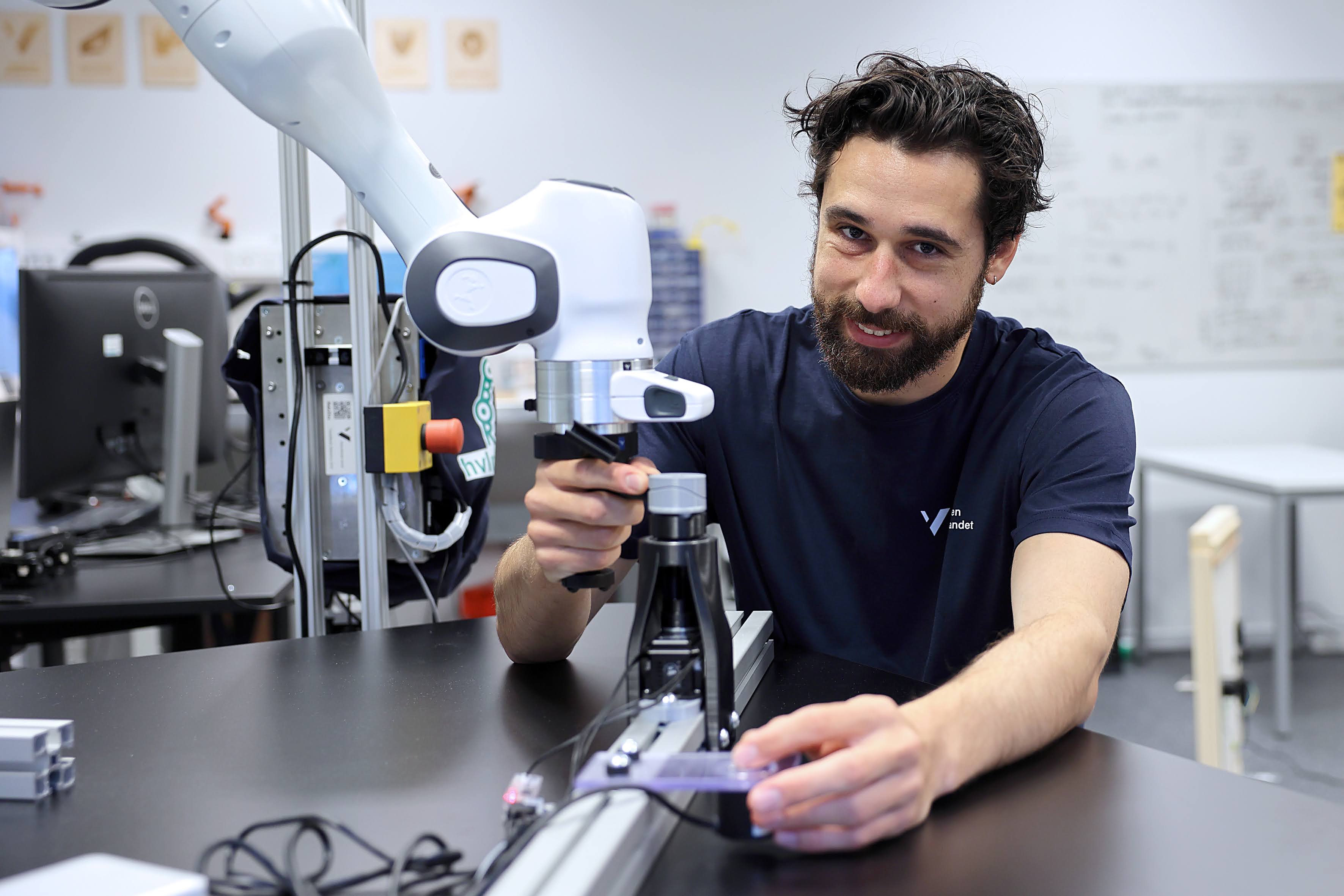
Daniel Schäle
Personalia
Daniel was born in Ravensburg, Germany. He obtained a bachelor’s degree in biomimetics at the Westphalian University of Applied Sciences in Bocholt, Germany and a master’s degree in mechatronics at the Wismar University of Applied Sciences in Wismar, Germany before relocating to Norway in the end of 2018 to start his PhD. He has been employed as a PhD student on Campus Førde and is working there as an assistant professor since January 2023.
Trial Lecture
Date: September 19th, at 10:15 AM
Location: Auditorium Sunnfjord (Førde)
Topic: Influences and potentials of foundation models on robotic automation and software architectures
Public Defence
Date: September 19th, at 1:15 PM
Location: Auditorium Sunnfjord (Førde)
Topic: Flexible Automation of Industrial Tasks with Learning from Demonstration
Chair of the Defence
Vice-Dean for Research at HVL, Stig Erik Jakobsen
Meeting ID: 616 2507 6278
Password: 831744
Supervisors
Main Supervisor: Professor Erik Kyrkjebø, HVL
Co-Supervisor: Associate Professor Martin F. Stølen, HVL
Assessment Committee
Professor Carina Bringedal, HVL (Committee Chair)
Assistant Professor Fares Abu-Dakka, New York University Abu Dhabi (First Opponent)
Professor Martin Steinert, Norwegian University of Technology and Science (Second Opponent)